Welcome to WordPress. This is your first post. Edit or delete it, then start writing!
Blog
-
Weekend Digital Media Round: How to make your digital marketing work harder and supercharge results, ‘Retail isn’t dead, but bad retail is’: Lowe’s on being customer-obsessed in age of AI, Why video-first social intelligence is the new standard for authenticity & More….
1.How to make your digital marketing work harder and supercharge results
Digital marketers can unlock better results without increasing budgets by making existing channels work harder together. The piece highlights how digital out-of-home advertising amplifies online performance through the “two‑screen effect,” boosting search, social engagement, and conversions when real‑world exposure supports digital campaigns. [Source: Marketing Tech News]
2. ‘Retail isn’t dead, but bad retail is’: Lowe’s on being customer-obsessed in age of AI
Lowe’s argues that retail’s survival depends on being deeply customer‑obsessed, not blindly chasing AI hype. The brand is using AI to remove friction, improve relevance and scale its marketplace, while keeping customer needs—not technology—as the guiding force behind every digital decision. [Source: The Drum]
3. Why video-first social intelligence is the new standard for authenticity
Video-first social intelligence is emerging as essential for brand authenticity as audiences now express real sentiment through visuals, tone, and context rather than text alone. Traditional text-based listening tools miss this nuance, leading to generic, synthetic marketing, while video-led analysis helps brands capture genuine human reactions and rebuild trust in an AI-heavy digital landscape. [Source: Marketing Tech News]
4. ‘Real-Time AI Video Is Nvidia’s New Pitch to Agencies—and It’s Turning Creatives Into Curators
Nvidia is advancing real-time AI video as a transformative shift in advertising, allowing brands and agencies to generate and adapt video content instantly based on prompts, significantly reducing production time and costs. This evolution is reshaping creative roles, where AI takes over execution while humans focus on direction, strategy, and refinement—marking a move towards faster, more automated, and scalable content creation. [Source: AdWeek]
5. SEO leads martech replacements, but not for the reason you think
SEO tools became the most frequently replaced martech category in 2025, not because the space is unstable, but because teams are upgrading to AI‑driven, more capable platforms. Cost pressures and changing search behavior are pushing marketers to consolidate, modernize, or even build custom SEO tools, while most other martech categories are actually seeing fewer replacements. [Source: Search Engine Land]
6. How Autonomous AI Agents Could Redesign E-Commerce Product Discovery
Agentic AI is shifting e‑commerce from reactive search to goal‑driven product discovery, where systems can act across multiple steps to resolve a shopper’s true intent rather than just answer queries. By maintaining persistent context, using multimodal inputs and executing tasks on a customer’s behalf, these agents could fundamentally change how complex purchases are researched and decided—provided trust, transparency and control are designed in from the start. [Source: Forbes]
7. Why CPC keeps rising – and what to do
CPCs are climbing across industries due to heavier advertiser competition, limited ad inventory, and Google’s AI-driven SERP changes that reduce visible placements and intensify auction pressure. While this pushes costs up, advertisers can offset the impact by focusing on high‑intent queries, protecting branded keywords from unauthorized bidders, and optimizing toward CPA rather than headline CPC. [Source: Search Engine Land]
AI is reshaping visual storytelling by accelerating generation and iteration, but it cannot replace the uniquely human qualities behind meaningful creative work. The piece highlights how lived experience, intentional ambiguity, and cultural empathy remain essential, positioning AI as a powerful collaborator that expands possibilities when guided by clear human intent and judgment. [Source: We and the Color]
9. How brands and agencies are operationalizing AI as the tech matures
Brands and agencies are moving beyond experimenting with AI to embedding it deeply into operations, focusing on centralized governance, real use cases and efficiency gains rather than hype. Leaders like WPP and Yum Brands are using internal data and tools to improve creative, media and decision‑making, while managing legal, reputational and workforce risks as more autonomous “agentic” AI emerges. [Source: Marketing Dive]
10. How to Use AI to Build and Scale Your Business Faster in 2026
AI is transforming how businesses scale by automating up to 80–90% of routine tasks, enabling small teams to achieve faster growth without increasing headcount. By integrating connected data systems and AI-led workflows across operations, marketing, product development, and customer support, companies can make quicker decisions, launch products faster, and improve conversions. Long-term success comes from embedding AI into core products while balancing automation with human oversight to maintain trust and quality. [Source: Analytics Insight]
-
Weekend Digital Media Round: AI Is Reshaping Marketing: Why CMOs Must Lead The Transformation, Why Most Enterprise SEO Operating Models Are Structurally Broken, Ads that sell what isn’t in stock: Quick commerce media’s hidden flaw? & More….
1.AI Is Reshaping Marketing: Why CMOs Must Lead The Transformation
AI is pushing marketing organizations to confront leadership, governance, and structural gaps rather than simply automate work. The piece argues that CMOs must lead with clarity—defining decision rights, accountability, and alignment—so AI scales effectively instead of amplifying chaos. Ultimately, AI becomes a competitive advantage only when treated as an operating-model transformation, not a tools rollout. [Source: Forbes]
2. Why Most Enterprise SEO Operating Models Are Structurally Broken
Enterprise SEO often fails not because of weak tactics, but because it’s positioned too late in the workflow, acting as a reactive reviewer instead of shaping decisions upfront. The piece argues that SEO must be embedded into product, content, and development processes—especially in the AI-driven search era—since structural foundations, not post-launch fixes, now determine visibility. [Source: Search Engine Journal]
3. Ads that sell what isn’t in stock: Quick commerce media’s hidden flaw?
Sponsored listings on quick‑commerce apps often promote products that aren’t actually available locally, leading to wasted ad spend and frustrated users. As retail media grows rapidly in India, experts argue that ad delivery must become tightly linked with real‑time inventory data to ensure ads run only where fulfilment is possible. The next phase of quick‑commerce advertising is expected to shift from impression‑led buying to availability‑led optimisation. [Source: Exchange4Media]
4. From SEO And CRO To Agentic AI Optimization (AAIO): Why Your Website Needs To Speak To Machines
Web optimization is shifting beyond traditional SEO and CRO as autonomous AI agents increasingly research, decide, and transact on behalf of users. The concept of Agentic AI Optimization (AAIO) emphasizes structuring websites to be understandable, trustworthy, and actionable for machines—not just humans. Businesses that adapt to this change can stay visible and relevant as AI-driven discovery and commerce become mainstream. [Source: Search Engine Journal]
The piece argues that digital advertising’s next phase is being built on third‑party AI infrastructure the industry doesn’t own or control, raising serious questions about data security, privacy, and decision‑making. It highlights how signal loss, stricter privacy rules, and the rise of agentic AI are converging, fundamentally reshaping attribution, monetization, and the marketing funnel. [Source: The Drum]
6. Emerging technology trends brands and agencies need to know about
Google’s Campaign URL Builder helps marketers create trackable links by adding UTM parameters like source, medium, and campaign name. These tagged URLs make it easier to analyze traffic sources, campaign performance, and experiment results in Google Analytics. [Source: Adage]
7. How new infrastructure, like the Model Context Protocol, is reshaping marketing workflows
AI agents are becoming central to marketing workflows, but their effectiveness depends on better infrastructure that connects them seamlessly with existing systems.The Model Context Protocol (MCP) introduces an open standard that adds structured context on top of APIs, enabling AI agents to plan, execute and optimize marketing tasks end‑to‑end across platforms like Amazon Ads, while reducing friction and manual effort. [Source: DigiDay]
8. The Real Customer Churn Problem? You’re Measuring It Too Late
Customer churn is rarely a sudden customer decision; it is the final outcome of unresolved issues across product, service, and overall experience. Companies often fail by measuring churn too late, focusing on exit data instead of identifying early warning signals embedded in day‑to‑day customer interactions. Preventing churn requires proactive, system‑wide accountability rather than last‑minute retention tactics. [Source: CMS Wire]
9. The New SEO: From Rankings To Recommendations In AI Search
Marketing campaigns often underperform not because of weak creative or channel choices, but due to gaps in identity data that prevent brands from reaching the right people. Fragmented profiles and missing or inconsistent identifiers reduce reach and relevance across touchpoints. Solving this requires strong identity resolution and enrichment to connect data accurately and activate audiences more effectively across platforms. [Source: AdWeek]
10.What’s the Missing Link in Consumer AI Agents?
Google’s Campaign URL Builder allows marketers to create trackable links by adding UTM parameters, making it easier to monitor where traffic comes from and how campaigns perform in Google Analytics. It helps standardize campaign data, enabling clearer analysis of user behavior, conversions, and overall marketing effectiveness. [Source: My Total Retail]
-
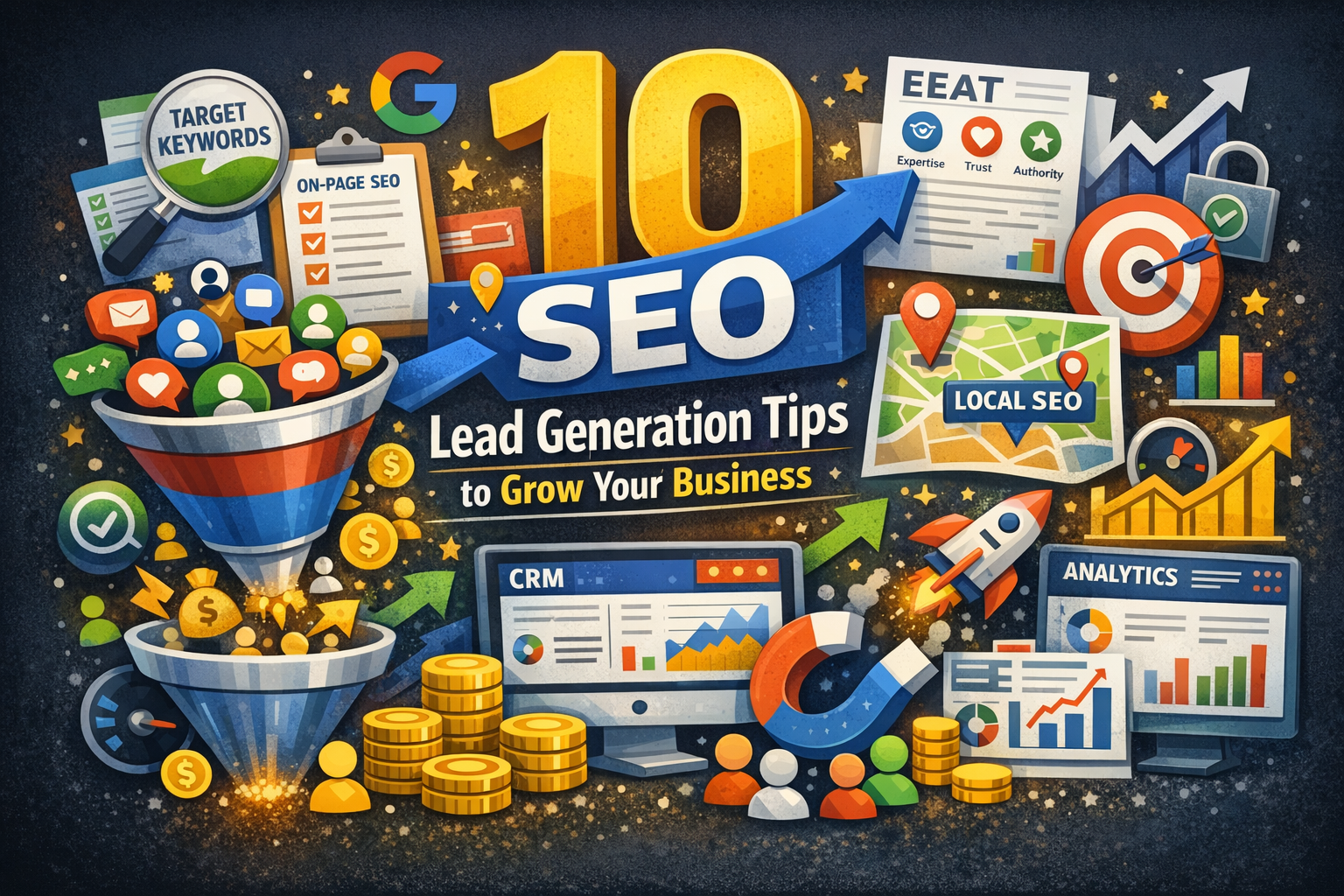
10 Seo Lead generation tips to grow your business
SEO led lead generation is the process of attracting potential customers through organic search engines like Google and converting them into real business opportunities, such as inquiries, demo requests, sign-ups, or sales.
Unlike traditional advertising, where businesses push messages to a broad audience, SEO works differently. It helps your business appear to people exactly when they are actively searching for a solution. This makes SEO one of the most powerful and sustainable ways to generate qualified leads.
For example, imagine someone searches for:
- “best CRM for small business”
- “SEO agency near me”
- “website redesign services”
These people are not casually browsing. They already have a problem and are looking for a solution. That means they are warm leads. SEO ensures that your website appears at this crucial decision-making stage.
How Does SEO Help in Lead Generation?
SEO helps generate leads by improving your visibility for high-intent searches. When your website ranks for keywords that show strong buying intent, you attract people who are more likely to convert.
Here’s how SEO supports lead generation:
- It drives targeted traffic
SEO focuses on ranking for keywords that your potential customers are actively searching for. This means the traffic you receive is highly relevant to your business.
- It builds long-term trust
When your website consistently appears in search results, users begin to see your brand as credible and authoritative. Over time, this trust increases conversion rates.
- It reduces cost per lead
Unlike paid ads, where you pay for every click, SEO brings organic traffic without ongoing ad spend. While it requires investment upfront, the long-term cost per lead becomes significantly lower.
- It brings consistent prospects
Once your pages rank well, they can continue generating leads for months or even years with proper optimisation.
- It supports scalable growth
As you create more targeted pages and improve your SEO, your lead flow grows steadily without relying entirely on advertising budgets.
SEO does not just increase website traffic, but it also attracts the right traffic.
How SEO Helps Generate Quality Leads
Not all website visitors are valuable. What truly matters in lead generation is quality.
SEO leads tend to be higher quality because users coming from search engines are:
- Already researching solutions
- Actively comparing options
- Closer to making a buying decision
For example, someone who clicks on a social media ad might not be actively looking for your service. However, someone searching “digital marketing services pricing” is already evaluating options. This is why SEO leads often convert better than cold outreach or passive campaigns.
10 SEO Lead Generation Tips to Grow Your Business
Let’s explore the most effective SEO strategies that can help you generate consistent leads.
Tip 1: Target High-Intent Keywords (Not Just High Volume)
Many businesses focus only on keywords with large search volumes. However, traffic alone does not guarantee leads.
Instead, focus on buyer-intent keywords such as:
- “hire SEO consultant”
- “best accounting firm in Mumbai”
- “digital marketing services pricing”
- “software demo request”
These keywords indicate that the user is ready to take action.
There are three main types of keyword intent:
- Awareness– The user wants to learn something.
- Consideration – The user is comparing options.
- Conversion – The user is ready to buy or contact.
For lead generation, transactional and commercial keywords usually deliver better results.
Tip 2: Optimise Content Around Search Intent
Ranking on Google is not enough. Your content must match what the user expects to find.
For example:
- If someone searches “SEO lead generation tips,” they expect a practical guide.
- If they search “SEO agency pricing,” they expect clear pricing information.
- If they search “best CRM tools,” they expect comparisons and recommendations.
Before creating content, ask yourself:
- What problem is this user trying to solve?
- What action are they likely to take next?
When your content aligns perfectly with intent, conversions improve significantly.
Tip 3: Create Conversion-Focused Landing Pages
Blog posts help attract awareness. However, landing pages are what generate leads.
You should create dedicated SEO-friendly pages for:
- Services
- Specific industries
- Locations
- Product offerings
A high-converting landing page should include:
- A clear and compelling headline
- Benefits and value propositions
- Social proof such as testimonials
- A lead form placed prominently
- A strong call-to-action (CTA)
Without proper landing pages, traffic may increase but leads will remain low.
Tip 4: Improve On-Page SEO for Every Lead Page
On-page SEO ensures that both search engines and users clearly understand your content.
Important elements include:
- Including your primary keyword in the title and H1
- Using proper heading structure (H2, H3)
- Writing compelling meta descriptions
- Adding internal links to relevant pages
- Optimising image alt text
- Including FAQ sections for better visibility in search features
Strong on-page optimisation improves rankings and increases user trust.
Tip 5: Strengthen Technical SEO
A website that loads slowly or functions poorly can lose leads even if it ranks well.
Key technical improvements include:
- Improving page speed
- Ensuring mobile responsiveness
- Fixing broken links
- Optimising Core Web Vitals
- Adding HTTPS security
- Removing duplicate content
A better user experience leads to better conversion rates.
Tip 6: Build Authority Through EEAT Content
Google values content that demonstrates:
- Expertise
- Experience
- Authoritativeness
- Trustworthiness
What Does Each Part of EEAT Mean?
Experience
This shows that the content creator has first-hand or practical experience.
For example:
- Sharing real client results
- Explaining what worked and what didn’t
- Describing practical implementation steps
Experience answers the question:
“Has this person actually done this before?”Expertise
This refers to knowledge and skill in a specific field.
For example:
- Demonstrating deep understanding of SEO strategies
- Explaining technical concepts clearly
- Publishing in-depth, accurate content
Expertise answers:
“Does this person know what they’re talking about?”Authoritativeness
Authority is about reputation.
It is built through:
- Industry recognition
- High-quality backlinks
- Mentions in trusted publications
- Strong brand presence
Authority answers:
“Is this website or brand recognised in this field?”Trustworthiness
Trust is the most important part.
Trust signals include:
- Clear contact information
- Transparent pricing
- Honest claims
- Real testimonials
- Proper citations
Trust answers:
“Can I rely on this information and this business?”Why EEAT Matters for Lead Generation
In lead generation, trust directly impacts conversions.
Even if you rank #1:
- If your website looks weak, users won’t convert.
- If your claims are not supported, users won’t trust you.
- If there is no proof of experience, users hesitate.
Tip 7: Use Local SEO to Generate Nearby Leads
If you are a service-based business, local SEO can be extremely powerful.
Optimise for:
- “near me” searches
- City-specific keywords
- Google Business Profile
Additional strategies include:
- Creating location-specific pages
- Collecting positive Google reviews
- Adding local schema markup
- Maintaining consistent business details (NAP: Name, Address, Phone)
This helps you attract leads from customers who are ready to buy locally.
Tip 8: Focus on Conversion Rate Optimisation (CRO)
Traffic alone does not guarantee results. You must optimise for conversions.
Simple CRO improvements include:
- Adding clear CTAs
- Offering free consultations
- Reducing unnecessary form fields
- Using chatbots or live chat
- Displaying trust badges
When SEO and CRO work together, lead generation improves dramatically.
Tip 9: Offer Lead Magnets
People are more likely to share their contact details when they receive value in return.
Effective lead magnets include:
- Free audits
- Downloadable guides
- Templates
- Industry reports
- Free trials or demos
For example:
“Get a Free SEO Audit Report in 24 Hours.”This approach converts organic visitors into real leads.
Tip 10: Track SEO Leads with Analytics and CRM
If you do not track your leads, you cannot improve performance.
Use tools such as:
- Google Analytics 4
- Google Search Console
- CRM software like HubSpot or Zoho
- Call tracking systems
Track:
- Form submissions
- Demo requests
- Phone calls
- Organic conversions
- Keyword-to-lead performance
SEO success should always be measured in leads and revenue, not just rankings.
Common SEO Lead Generation Mistakes
Avoid these common errors:
- Focusing only on traffic volume
- Not adding CTAs on blog posts
- Ignoring technical SEO
- Weak landing page structure
- No trust signals
- Not tracking conversions
- Relying only on blogs without service pages
Successful SEO lead generation requires strategy, structure, and optimisation.
How Long Does SEO Take to Generate Leads?
SEO is not an instant solution, but it is sustainable.
Typical timeline:
- 0–3 months: Foundation and indexing
- 3–6 months: Traffic growth
- 6–12 months: Consistent lead generation
- 12+ months: Compounding returns
While competitive industries may take longer, SEO delivers long-term value compared to short-term ad campaigns.
Is SEO Better Than Paid Ads for Lead Generation?
Both SEO and paid ads have benefits.
SEO provides:
- Long-term organic traffic
- Lower cost per lead over time
- Increased brand trust
- Sustainable growth
Paid ads provide:
- Immediate visibility
- Quick testing opportunities
The most effective strategy is to use paid ads for short-term results while building SEO for long-term lead stability.
How Do I Track SEO-Generated Leads?
Track SEO leads by setting up:
- GA4 conversion events
- UTM attribution
- CRM lead source mapping
- Search Console performance reports
This helps identify which pages + keywords drive revenue.
Conclusion
SEO is one of the most reliable and cost-effective ways to generate qualified leads. When implemented correctly, it attracts high-intent prospects, builds trust, and delivers consistent results over time.
By focusing on search intent, strong landing pages, technical optimisation, authority building, and proper tracking, businesses can turn SEO into a powerful lead generation engine that drives sustainable growth month after month.
Frequently Asked Questions
- What types of businesses benefit most from SEO-led lead generation?
SEO-led lead generation works especially well for all businesses where customers actively search online before making a decision, and can benefit significantly from SEO. The key factor is whether your audience uses search engines to compare solutions.
- What is the difference between SEO traffic and SEO leads?
SEO traffic refers to the number of users visiting your website from organic search results. SEO leads, on the other hand, are visitors who take a meaningful action, such as filling out a form, requesting a demo, booking a consultation, or making a purchase.
- How can I identify high-intent keywords for lead generation?
High-intent keywords usually include action-driven words such as “hire,” “buy,” “pricing,” “consultation,” “near me,” “services,” or “demo.” You can identify these keywords using tools like Google Search Console, keyword research tools, competitor analysis, and reviewing customer queries. These keywords indicate that the user is closer to making a decision.
- Should I focus more on blogs or service pages for lead generation?
Both are important, but they serve different purposes. Blogs help attract informational traffic and build authority, while service pages convert users who are ready to take action. For strong SEO-driven lead generation, businesses should use blogs to build awareness and strategically guide users to high-converting service or landing pages.
- How important is content quality for SEO lead generation?
Content quality is critical. Search engines prioritise content that demonstrates expertise, accuracy, and trustworthiness. High-quality content builds credibility with users, improves engagement, and increases conversion rates. Poor or thin content may rank temporarily but rarely generates sustainable leads.
- Can SEO generate leads without paid advertising?
Yes, SEO can generate consistent leads without paid advertising once your pages rank well. However, SEO requires time, strategic planning, and ongoing optimisation. Many businesses use paid ads initially for faster visibility while building long-term organic lead flow through SEO.
- How does technical SEO impact lead generation?
Technical SEO ensures your website loads quickly, functions properly on mobile devices, and provides a smooth user experience. If a website is slow or difficult to navigate, users may leave before converting. Strong technical performance directly improves both rankings and lead conversion rates.
-
Weekend Digital Media Round-Up: How To Use AI To Streamline Time-Consuming SEO Tasks, How AI Agents Decide Which Brands To Recommend: Trust Is The New Ranking Factor, AI in the comparison and purchase process: Report & More…
1.How To Use AI To Streamline Time-Consuming SEO Tasks
AI can automate repetitive SEO tasks like creating metadata, structuring content, organizing project briefs, and segmenting keywords. It also speeds up competitor analysis and SERP reviews, helping teams focus on strategic decisions. While these efficiencies save time and effort, human oversight remains essential to ensure accuracy and maintain quality. [Source: Search Engine Journal]
2. How AI Agents Decide Which Brands To Recommend: Trust Is The New Ranking Factor
AI agents will only recommend brands they trust, making transparency and reliability more important than traditional SEO tricks. Brands must offer clear, verifiable information, predictable processes, and strong third‑party validation. The goal shifts from gaining visibility to being “eligible” for an AI’s shortlist. To win, brands need to be the safest, most defensible choice an agent can justify. [Source: The Search Engine Journal]
3. AI in the comparison and purchase process: Report
AI is rapidly becoming the starting point for online discovery and purchases, especially among Gen Z and heavy users who increasingly rely on dedicated AI platforms over traditional search. While embedded AI in search tends to complement existing habits, standalone AI tools are beginning to replace search for brand and product discovery. However, concerns around privacy, accuracy, and trust continue to limit broader adoption across higher‑stakes tasks. [Source: Marketing Tech News]
4. Why most online retail “strategies” are just panic dressed up as innovation
Online retail keeps chasing new trends out of urgency rather than strategy, leading to soaring acquisition costs and poor customer retention. The brands that thrive are the ones that commit to a clear position, invest in retention fundamentals, and resist the pressure to constantly pivot. Real strategy shows up as focus, consistency, and patience—not novelty. [Source: DM News]
5. Facebook adds AI-powered updates to Marketplace
Meta has introduced new AI tools in Facebook Marketplace that auto-generate product descriptions, pricing suggestions, and shipping labels to simplify listings. Sellers can also enable AI-powered replies to common buyer questions and access AI‑generated profile summaries. The updates aim to streamline selling for Marketplace’s more than 1.1 billion users. [Source: The Social Media Today]
6. Digital marketing fatigue is real. So, what happens beyond the screen?
People are overwhelmed by constant online noise, leading to a rise in digital fatigue and shrinking attention spans. As audiences disconnect from screens, they increasingly seek real-world, immersive experiences that feel more human and memorable. Brands are shifting toward offline, experiential marketing to create deeper emotional impact beyond the endless scroll. [Source: The Drum]
7. AI Is Everywhere at SXSW, but Humanity Still Leads
AI dominated conversations at SXSW as marketing and tech leaders discussed how it’s transforming workflows, personalization, and creativity. Executives emphasized that AI doesn’t always save time and must be paired with strong human‑led values and ethical guardrails. They agreed that while AI unlocks new capabilities, brand identity, trust, and human judgment remain essential. [Source: The Adweek]
8. Online bot traffic will exceed human traffic by 2027, Cloudflare CEO says
AI-driven bots are rapidly increasing web traffic, and Cloudflare CEO Matthew Prince predicts that bot traffic will surpass human traffic by 2027 due to the heavy data needs of generative AI. This surge is pushing the internet toward new infrastructure models like on‑demand sandboxes for AI agents, while also raising challenges for websites that must handle the growing load. [Source: Tech Crunch]
9. The rise of generative engine optimization
AI-driven search platforms now deliver synthesized answers instead of link lists, changing how online visibility works. Generative Engine Optimization (GEO) is becoming essential alongside traditional SEO to ensure brands appear in AI-generated responses. Digital marketers must adjust to this AI‑first search environment to stay discoverable. [Source: Adgully]
10. Why CPM-led media planning is losing relevance in the age of AI
CPM is becoming an outdated metric in India’s low-cost, high-scale digital market, where impressions are abundant but real impact depends on influencing consumer behaviour. With AI improving media optimisation, true effectiveness now lies in measuring behavioural signals—such as changes in search intent—rather than relying on reach or delivery metrics. [Source: Social Samosa]
-
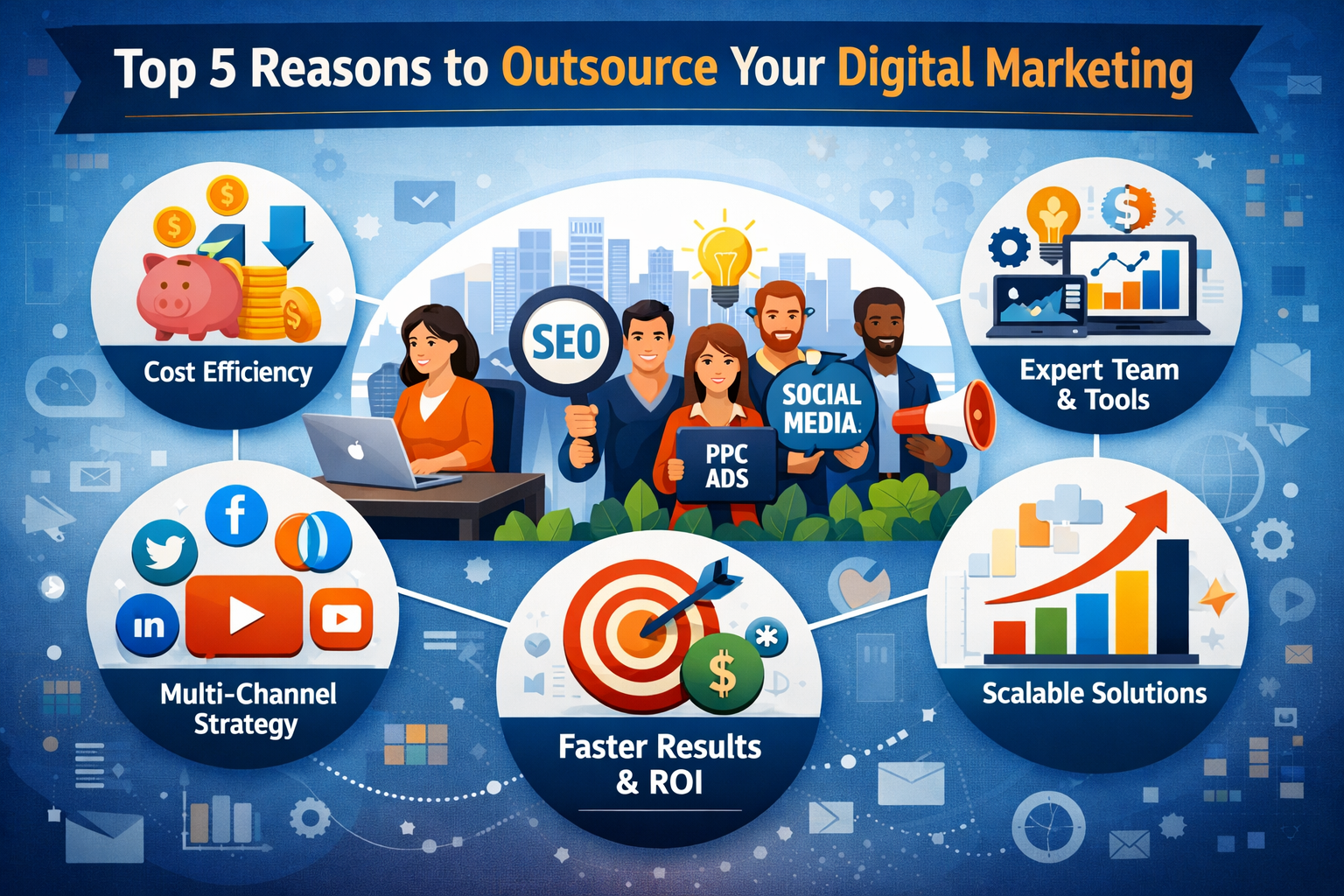
Top 5 Reasons to Outsource Your Digital Marketing – A Complete Guide for Businesses
Digital marketing for businesses is no longer optional today, but it is essential for growth, visibility, customer acquisition, and competitive success.
However, managing digital marketing in-house can be expensive, time-consuming, and difficult without the right expertise.
That’s why many businesses today are choosing to outsource digital marketing services to professional agencies and specialists.
In this guide, we’ll explore:
- What does digital marketing outsourcing mean?
- The top 5 reasons to outsource marketing
- When outsourcing makes the most sense
- How outsourcing improves ROI, scalability, and business focus
Introduction to Digital Marketing Outsourcing
Digital marketing today is no longer limited to just posting on social media or running a few ads. It includes multiple channels and moving parts that need to work together to generate real results, such as leads, traffic, and conversions.
Some of the key areas of digital marketing include:
- Search Engine Optimisation (SEO) to improve website rankings and organic traffic
- Social media marketing to build brand presence and engage audiences
- Paid advertising (PPC) across platforms like Google, Meta, LinkedIn, and YouTube
- Email marketing campaigns for nurturing leads and customer retention
- Content marketing such as blogs, landing pages, videos, and marketing copy
- Analytics and reporting to track performance and optimise campaigns regularly
For growing businesses, managing all of these functions in-house can quickly become overwhelming. It requires time, skilled professionals, paid tools, consistent planning, and constant optimisation. Without the right expertise, businesses may also end up spending money on campaigns that don’t deliver measurable returns.
This is where digital marketing outsourcing becomes a smart solution.
By outsourcing to a professional agency, businesses can access experienced talent, industry-level tools, and faster execution in one place, without the cost and effort of building a full internal marketing department. It also allows business owners and internal teams to focus on core operations, while experts handle strategy, performance, and growth online.
LS Digital, through its specialised vertical Media Alchemy, focuses on delivering integrated, performance-driven digital marketing solutions.
What is Digital Marketing Outsourcing?
Digital marketing outsourcing is the process of hiring an external agency or marketing partner to manage part or all of their online marketing activities.
Instead of doing everything in-house, businesses outsource services like:
- SEO management
- Social media content and ads
- PPC campaigns
- Website optimisation
- Email marketing
- Lead generation
Is Outsourcing Digital Marketing Cost-Effective?
Yes, outsourcing is often far more cost-effective than hiring, training, and managing a full in-house digital marketing team.
To build an internal team that can handle digital marketing properly, a business typically needs multiple specialists — such as an SEO expert, a performance marketer, a content writer, a designer, a social media manager, and an analytics specialist. And beyond hiring, there’s also the ongoing cost of training, upskilling, and keeping the team updated with platform changes.
When you outsource, you save significantly on:
- Full-time salaries across multiple roles
- Employee benefits and HR overhead
- Paid marketing tools and software subscriptions
- Training and upskilling costs
- Trial-and-error execution, which often leads to wasted ad spends and slow results
More importantly, outsourcing gives you access to a ready-to-go team of experts across different levels, from strategists and senior specialists to execution-focused professionals, all working together. Instead of relying on one or two generalists, you get the benefit of a complete digital marketing setup without the cost of building it from scratch.
Top 5 Reasons to Outsource Your Digital Marketing
Let’s break down the most important reasons why businesses choose to outsource digital marketing — and why working with a full-service, integrated agency delivers stronger, faster, and more measurable outcomes than managing everything in-house.
Reason 1: Cost Efficiency Without Compromising Quality
One of the biggest reasons businesses outsource digital marketing is to control costs while improving performance.
Building a capable in-house marketing team requires hiring multiple specialists, such as:
- SEO specialists
- Content writers and editors
- Graphic designers
- Paid media and performance marketers
- Social media managers
- Data and analytics professionals
This isn’t just a hiring challenge — it’s a long-term financial commitment that includes salaries, benefits, training, software subscriptions, and management overhead.
Outsourcing to an agency solves this by offering:
- Access to multiple specialists at one consolidated cost
- No recruitment, onboarding, or training expenses
- Use of premium tools and platforms already built into the service
- Flexible pricing models that grow with your business
Instead of paying for individual roles, businesses get an integrated team working together, making outsourcing especially effective for startups, SMEs, and scaling brands.
Reason 2: Access to Multi-Level Expertise & Advanced Tools
Digital marketing is not a single skill — it’s a constantly evolving ecosystem. Search algorithms change, ad platforms update policies, and audience behaviour shifts rapidly.
An experienced agency brings together:
- Senior strategists who plan campaigns aligned with business goals
- Mid-level specialists who optimise performance and execution
- Execution-focused experts who handle daily tasks with precision
This layered expertise ensures campaigns are both strategically sound and operationally efficient.
In addition, agencies invest in premium tools such as:
- SEO platforms (SEMrush, Ahrefs)
- Analytics tools (GA4, Search Console, Data Studio)
- CRM and automation platforms (HubSpot, marketing automation tools)
For example, when a business outsources SEO to an agency, they instantly gain access to:
- In-depth keyword research and competitive analysis
- Technical SEO audits and fixes
- Content optimisation and on-page improvements
- Link-building and authority growth strategies
All of this happens without the learning curve and trial-and-error that often slows down in-house teams.
Reason 3: Integrated Approach Across All Digital Channels
One of the biggest advantages of hiring a full-service agency is integration.
Instead of managing SEO, content, paid media, social media, and analytics separately, agencies bring everything together under one strategy. This ensures:
- SEO insights inform content creation
- Content supports paid media performance
- Social media aligns with brand messaging
- Analytics guide optimisation across all channels
An integrated agency doesn’t work in silos — it connects every digital effort to business objectives. This unified approach leads to better consistency, stronger messaging, and higher conversion rates.
Reason 4: Scalability Backed by Real-World Experience
Marketing requirements are rarely constant.
At different stages, businesses may need:
- Full-funnel campaign launches
- Festive or seasonal promotions
- Aggressive paid media scaling
- Increased content production
- Short-term performance boosts
Agencies offer built-in scalability because they already have teams and systems in place. Businesses can:
- Scale services up or down without hiring or layoffs
- Launch campaigns faster with proven processes
- Adapt quickly to market shifts and seasonal demand
More importantly, agencies work with multiple clients across industries. This exposure helps them identify patterns, apply best practices, and avoid mistakes — making them far more results-oriented than isolated in-house teams.
Reason 5: Faster Results, Clear Accountability & Measurable ROI
Agencies operate with performance frameworks, defined KPIs, and accountability baked into their process.
Outsourcing digital marketing leads to:
- Faster execution using tested workflows
- Continuous optimisation based on data
- Better audience targeting and budget efficiency
- Regular performance reviews and improvements
Most professional agencies provide structured reporting on:
- Website traffic and engagement
- Lead generation and conversion rates
- Cost per acquisition (CPA)
- Search engine rankings
- ROI from paid campaigns
The result?
Marketing shifts from experimentation to measurable, revenue-driven outcomes — with clear ownership and accountability.What Digital Marketing Services Can Be Outsourced?
Businesses can outsource almost every part of digital marketing, including:
Commonly outsourced services:
- SEO strategy and content optimisation
- Social media marketing outsource (Instagram, LinkedIn, Facebook)
- PPC advertising (Google Ads, Meta Ads)
- Website design and landing pages
- Content writing and blogging
- Email marketing automation
- Conversion Rate Optimisation (CRO)
- Analytics and reporting dashboards
Outsourcing allows businesses to create an integrated online presence without internal complexity.
How Does Outsourcing Improve Marketing Performance?
Outsourcing improves performance by providing:
- Multi-channel expertise
- Data-driven decision-making
- Advanced marketing tools
- Dedicated optimisation teams
- Consistent campaign monitoring
Agencies often outperform internal teams because they work across industries, allowing them to bring best practices and insights.
How Do I Choose the Right Digital Marketing Agency to Outsource To?
Choosing the right partner is essential for trust and long-term success.
Look for an agency with:
- Proven case studies and results
- Transparent pricing and deliverables
- Strong communication process
- Industry experience
- Clear KPIs and reporting
- Google Partner or Meta certifications
Ask these questions:
- What results have you delivered for similar businesses?
- How will you measure success?
- Who will manage my account directly?
Trustworthy agencies operate as growth partners, not vendors.
Why Outsourcing is a Smart Growth Move
Outsourcing digital marketing is no longer just a cost-saving tactic — it is a competitive strategy.
With the right outsourcing partner, businesses gain the expertise of an entire marketing department — without the overhead.
FAQ Section
Is outsourcing digital marketing cost-effective?
Yes, outsourcing is often more cost-effective than hiring a full in-house team because it reduces salary, training, and tool expenses.
What services can be outsourced in digital marketing?
SEO, social media marketing, PPC ads, content creation, email marketing, analytics, and website optimisation can all be outsourced.
Does outsourcing improve marketing performance?
Yes, outsourcing gives access to experienced specialists, advanced tools, faster execution, and continuous optimisation.
How do I choose the best agency to outsource marketing?
Choose an agency with proven results, transparent reporting, strong communication, certifications, and relevant industry expertise.
-
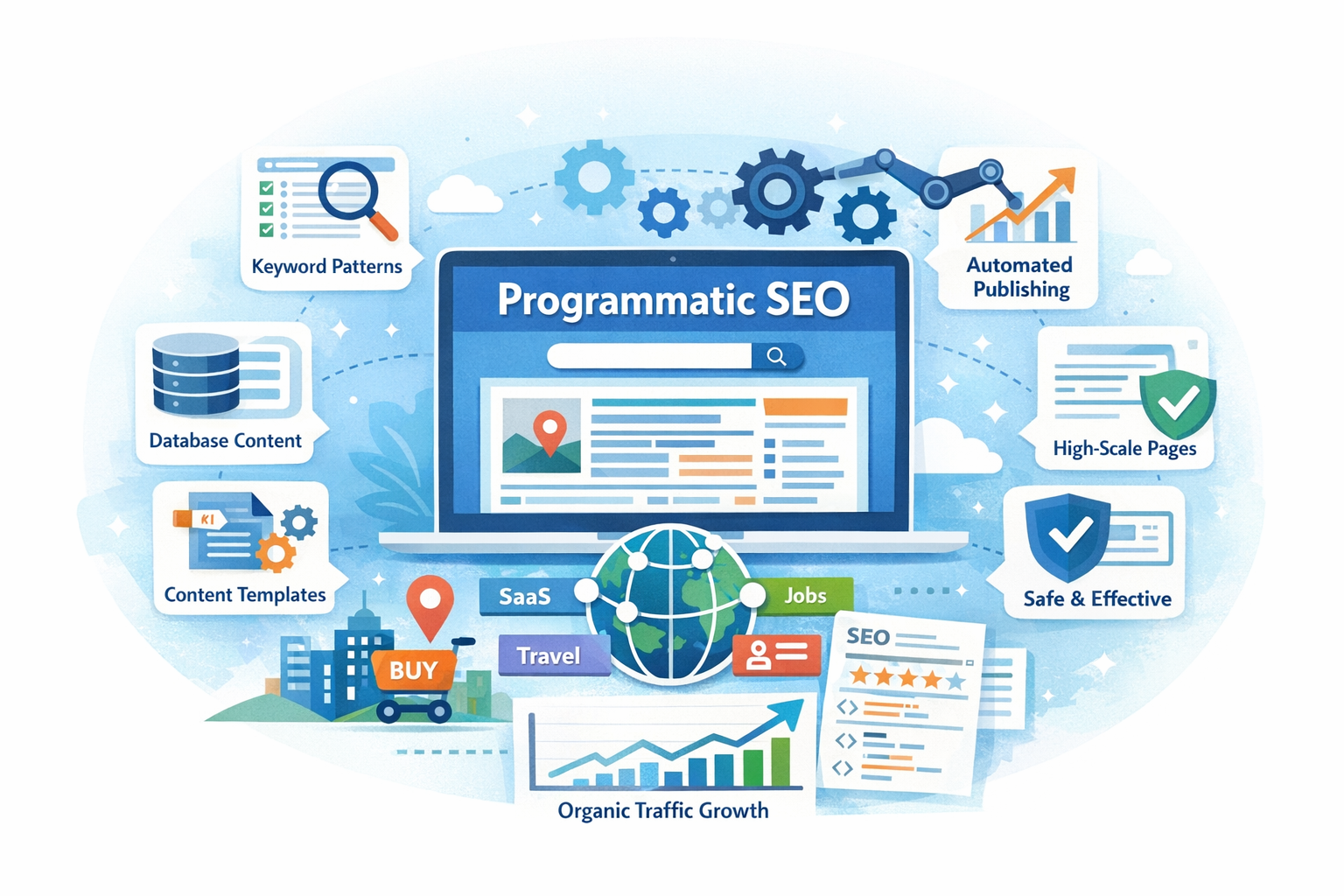
What is Programmatic SEO: A Complete Guide
What is Programmatic SEO? A Complete Guide
Programmatic SEO is one of the most powerful strategies modern websites use to generate thousands of high-ranking pages at scale. From travel aggregators to eCommerce marketplaces, programmatic SEO helps brands unlock massive organic traffic through automation, structured content, and data-driven publishing.
In this guide, you’ll learn:
- What programmatic SEO means
- How it works
- Differences between traditional SEO vs programmatic SEO
- Use cases, benefits, examples, and safety guidelines
- How to set up programmatic SEO the right way
Introduction to Programmatic SEO
Search engines today reward websites that provide relevant, scalable, and structured information for users. With millions of long-tail searches happening daily, manually creating content for each keyword is no longer practical.
That’s where Programmatic SEO comes in.
Programmatic SEO helps businesses create hundreds or even thousands of SEO-optimised landing pages automatically without sacrificing relevance or quality.
What is Programmatic SEO?
Programmatic SEO is a strategy where web pages are created at scale using:
- Templates
- Structured keyword patterns
- Database-driven content
- Automation tools
Instead of writing every page manually, programmatic SEO allows you to generate pages dynamically based on search demand.
For example:
- “Best hotels in Delhi”
- “Best hotels in Mumbai”
- “Best hotels in Bangalore”
Instead of writing 500 separate pages manually, you build one template and populate it programmatically.
How Programmatic SEO Works?
Programmatic SEO works through a combination of SEO research, structured content templates, and automation systems to create large numbers of search-optimised pages efficiently and consistently.
Key components include:
1. Keyword + Page Pattern Discovery
You identify scalable keyword structures that can be repeated across hundreds or thousands of pages, such as:
- Services in [City]
- Products under [Category]
- Jobs in [Industry]
- Tools for [Use case] These patterns help capture long-tail search intent at scale.
2. Database-Driven Content
Instead of writing each page manually, content is pulled dynamically from structured data sources like:
- Product catalogues
- Location directories
- SaaS feature lists
- Public datasets This ensures accuracy, consistency, and easy updates across all pages.
3. Template-Based Page Creation
A reusable page format is created that follows SEO best practices, including:
- SEO-friendly headings
- FAQs for long-tail queries
- Schema markup for rich results
- Internal links for better crawlability Each page uses the same template but displays unique data.
4. Automated Publishing
Pages are generated and published automatically using:
- CMS integrations
- No-code tools
- Static site generators
- Custom scripts This allows teams to launch and scale content quickly without manual effort.
Difference Between Traditional SEO & Programmatic SEO
Search engine optimisation has evolved far beyond just writing blog posts and building backlinks. Businesses use two powerful but very different SEO approaches: Traditional SEO and Programmatic SEO. While both aim to improve organic visibility, they work in distinct ways and serve different goals.
Here is a clear comparison:
Feature Traditional SEO Programmatic SEO Content creation Manual writing Automated generation Scale Limited pages Thousands of pages Best for Blogs, guides Directories, marketplaces Keyword targeting Broad + selective Long-tail + structured Speed Slower Fast publishing Data requirement Low High - Traditional SEO builds authority through content depth.
- Programmatic SEO builds traffic through content scale.
How to Set Up Programmatic SEO (Step-by-Step Guide)
Programmatic SEO is one of the most powerful ways to scale organic traffic, but it only works when executed strategically. It combines keyword research, data, templates, and technical SEO to create thousands of high-intent pages without sacrificing quality.
Here’s how to learn and implement programmatic SEO the right way.
Step 1: Perform Keyword Research for Programmatic SEO
Keyword research is the foundation of any successful programmatic SEO strategy. Unlike traditional SEO, where you target a limited set of keywords, programmatic SEO focuses on patterns and repeatable search queries.
Instead of looking for single keywords, look for keyword formulas.
Look for keyword patterns like:
- “Top restaurants in [city]”
- “Best [tool] for [industry]”
- “[product] alternatives”
- “Cheap flights from [A] to [B]”
Use tools like:
- Google Keyword Planner
- Ahrefs / SEMrush
- Google Autosuggest
- Search Console data
Step 2: Create a Scalable Content Template
Once you have identified keyword patterns, the next step is to build a scalable content template. This template acts as the backbone for every programmatic page.
A strong programmatic SEO template should include:
- SEO title + meta description (dynamically generated)
- H1 with keyword variation
- Structured subheadings (H2, H3) for clarity
- Unique introductory text using variables
- Data tables, listings, or comparisons
- FAQs for Answer Engine Optimisation (AEO) and Generative Engine Optimisation (GEO)
- Contextual internal links
Each page pulls data from a database or spreadsheet and inserts it into predefined sections.
Example:
“Best CRM software for real estate”
“Best CRM software for healthcare”Same structure, different intent and data.
Step 3: Use Structured Data and Schema Markup
Structured data helps search engines understand your content better, which is increasingly important for AI-powered search experiences.
By adding schema markup, you increase visibility in:
- Rich results
- Featured snippets
- AI overviews
- Voice search responses
Essential schema types for programmatic SEO:
- FAQ schema – improves SERP visibility and AEO
- Product schema – for tools, software, and eCommerce
- Local Business schema – for city or location pages
- Review schema – for trust and CTR improvement
Schema doesn’t guarantee rankings, but it significantly increases eligibility for enhanced search features.
Step 4: Ensure Content Uniqueness but Avoid Thin Pages
One of the biggest risks in programmatic SEO is creating thin or duplicate content. Google does not reward mass-produced pages unless they provide unique value.
To keep pages helpful and index-worthy, add layers of originality.
Ways to ensure content uniqueness:
- Custom descriptions instead of generic text
- Location-specific insights (trends, tips, regulations)
- Expert commentary or editorial notes
- User reviews or ratings
- Dynamic FAQs based on intent
- Fresh data updates
Even small variations can make a big difference when scaled across hundreds of pages.
Rule of thumb: Each page should be able to stand on its own, even without internal links.
Step 5: Build Internal Linking at Scale
Internal linking is what turns programmatic SEO pages into a connected ecosystem, rather than isolated URLs.
A strong internal linking structure:
- Improves crawlability
- Distributes link equity
- Strengthens topical authority
- Helps pages rank faster
Common programmatic internal linking structures:
- City → Category → Listing
- Country → State → City pages
- Product → Alternatives → Reviews
- Use case → Tool → Comparison
Use dynamic internal links that automatically update as new pages are added.
Example:
- “Best restaurants in Mumbai” links to
- “Italian restaurants in Mumbai”
- “Top fine dining restaurants in Mumbai”
This creates semantic relationships that search engines love.
Is Google Ads Considered Programmatic?
No — Google Ads is not Programmatic SEO.
Google Ads and programmatic SEO are often mixed up because both use automation, but they belong to completely different marketing channels.
What Google Ads actually is
Google Ads is a paid advertising platform. You bid on keywords, write ad copy, and pay every time someone clicks your ad.
Even when campaigns are automated (Smart Bidding, Performance Max, Dynamic Search Ads), they are still:
- Paid placements
- Budget-driven
- Dependent on cost-per-click
Once you stop paying, traffic stops immediately.
What is Programmatic SEO?
Programmatic SEO is an organic search strategy. It focuses on:
- Creating large numbers of SEO-optimised pages
- Ranking naturally in search results
- Driving traffic without paying per click
Automation is used only for content creation and page generation, not for buying visibility.
Why do people get confused?
The word programmatic is widely used in advertising to describe automation, so many assume:
“If it’s automated, it must be programmatic.”
But that’s not true.
The real distinction:
- Programmatic Ads = automated paid campaigns
- Programmatic SEO = automated organic pages
One buys traffic. The other earns it.
Is Programmatic SEO Safe Under Google Guidelines?
Yes, programmatic SEO is completely safe when done correctly.
Google does not penalise automation. In fact, Google has clearly stated that content creation methods, whether human, automated, or AI-assisted, are not the issue.
The issue is quality and usefulness.
What Google actually penalises?
Google penalises pages that exist only to manipulate rankings, regardless of whether they were written by humans or generated automatically.
This includes:
- Thin content with little or no value
- Spam-like, mass-generated pages
- Duplicate or near-duplicate pages
- Keyword stuffing and forced optimisation
- Pages that fail to satisfy search intent
Bad programmatic SEO gets penalised, not programmatic SEO itself.
When Programmatic SEO Is Safe and Effective
Programmatic SEO aligns with Google’s guidelines when it puts users first.
It is safe when:
- Pages are genuinely useful
Each page should help users make a decision, find information, or compare options, not just exist for indexing.
- Content is unique, even at scale
Templates can be shared, but the content within them must vary:
- Different data points
- Different insights
- Different context
Uniqueness doesn’t mean long, but it means meaningful.
- User experience is strong
Pages should:
- Load fast
- Be easy to navigate
- Be readable and scannable
- Work well on mobile
Google increasingly evaluates how users interact with pages, not just what’s written on them.
- Pages satisfy search intent
If someone searches:
- “Best CRM for startups”
They would expect comparisons, pros and cons, pricing or features, not generic filler text.
When pages clearly match intent, programmatic SEO performs exceptionally well.
Use Cases and Examples of Programmatic SEO
Programmatic SEO works best for industries with structured search demand.
Popular examples include:
- Travel Websites
- Hotels in [city]
- Flights from [A] to [B]
- eCommerce Platforms
- Shoes under ₹2000
- Best laptops for students
- SaaS Comparison Pages
- Zoom alternatives
- CRM tools for startups
- Job Portals
- Marketing jobs in Bangalore
- Remote developer roles
- Real Estate Directories
- Apartments in South Delhi
- Villas in Goa under 2Cr
What Types of Websites Benefit Most from Programmatic SEO?
Programmatic SEO is ideal for websites that have:
- Large datasets
- Repeatable search patterns
- Multiple categories or locations
- Directory-style content
Best suited for:
- Marketplaces
- Aggregators
- SaaS companies
- Travel platforms
- Local service directories
Programmatic SEO Ideas for Growth
If you’re looking for programmatic SEO ideas, try:
- Location-based landing pages
- Product comparison pages
- Industry tool directories
- Automated FAQ hubs
- Glossary + definition pages
Key takeaways:
- Programmatic SEO creates pages automatically using templates + data
- It helps capture thousands of long-tail keywords
- It works best for directories, marketplaces, SaaS, and travel brands
- Google supports it when pages are high-quality and user-first
- Programmatic SEO is essential for GEO + AI-first search visibility
When combined with traditional SEO, expert content, structured data, and EEAT principles, programmatic SEO becomes a long-term growth engine.
Frequently Asked Questions
What is programmatic SEO in simple words?
Programmatic SEO means creating many SEO landing pages automatically using templates and structured data.
Is programmatic SEO safe?
Yes, if you avoid thin content and focus on helpful, user-first pages.
How does programmatic SEO work?
It uses keyword patterns + templates + databases to publish pages at scale.
What is the difference between SEO and programmatic SEO?
Traditional SEO focuses on manual content creation, while programmatic SEO focuses on automated scalable page generation.
-
Weekend Digital Media Round: The dark side of india’s digital gold rush, The future of advertising: integrating creativity and technology, AI is the latest gatekeeper between brands and buyers & More….
1.The dark side of india’s digital gold rush
India’s rapid digital commerce growth is increasingly tainted by “dark patterns” — deceptive design tactics that trick consumers into overpaying or signing up for unwanted services. Weak regulation and poor data protection allow these practices to flourish across sectors, eroding consumer trust and exposing users to financial and privacy risks. [Source: ET Brand Equity]
2. The future of advertising: integrating creativity and technology
Creativity and technology are increasingly converging to shape the future of advertising, with connected TV (CTV) emerging as a key platform. By using data, automation, and personalization, brands can deliver more interactive, tailored experiences that strengthen audience engagement and transform how advertising works. [Source: The Drum]
3. AI is the latest gatekeeper between brands and buyers
AI tools like ChatGPT and Google’s AI Overviews are becoming key intermediaries between brands and consumers, shaping purchase decisions with single, synthesized recommendations. Because these systems can portray the same brand very differently, companies are now optimizing content for bots rather than people, flooding the web with promotional material. As AI-driven shopping grows, traditional SEO and advertising rules are rapidly becoming obsolete and unstable. [Source: Seamafor]
4. From a Tool to a Partner: the Agentic AI Difference
Generative AI mainly responds to prompts for specific tasks like content creation, while agentic AI can plan, reason, and act autonomously to achieve business goals. The article explains how agentic AI shifts marketing from manual execution to workflow orchestration, acting like a virtual teammate that manages end‑to‑end processes. This evolution enables faster time‑to‑market, better use of data, and frees humans to focus on strategy and governance. [Source: CMS Wire]
5. 5 Things I Learned About The Future Of Search From Liz Reid’s Latest Interview
Search is moving beyond traditional blue links toward AI‑driven answers, agent interactions, and more personalized experiences. Google expects AI agents to handle much of web activity, while Search, Gemini, and AI Mode continue to evolve toward a new blended or entirely new product. Success in this future will depend on truly original content, stronger personalization, and emerging monetization models like micropayments. [Source: Search Engine Journal]
6. LinkedIn is a leading source for AI answers
LinkedIn has emerged as one of the most-cited sources in AI chatbot answers, ranking just behind Reddit in a large SEMrush study and climbing rapidly in other reports. The findings highlight LinkedIn’s growing role in AI-driven discovery, making it a critical platform for marketers and brands aiming to appear in AI-generated responses as more users start searches through AI tools. [Source: Social Media Today]
7. Domain-specific AI models are the future of enterprise ROI
Enterprises are increasingly realizing that **domain‑specific AI models** deliver far better ROI than large, general‑purpose models because they are trained on proprietary business data and processes. These smaller, focused models understand real operational context, improve accuracy, lower costs, and enable practical personalization, proving that depth and relevance matter more than sheer model size when driving measurable business value. [Source: Tech Radar]
8. The New SEO: From Rankings To Recommendations In AI Search
Search is shifting from blue‑link rankings to AI‑driven recommendations, where users ask a question, get an instant answer, and act without visiting multiple websites. As AI summaries reduce clicks, SEO success now depends on being trusted and cited within AI answers—by offering clear, helpful content, consistent brand signals, and strong third‑party credibility—rather than just ranking high in search results. [Source: Forbes]
9. What is brand experience and why is it so crucial right now?
Brand experience refers to the way people interact with a brand across every touchpoint, combining visual identity, behaviour, and emotional connection across physical, digital, and human experiences. In an increasingly competitive and connected world, strong brand experiences help businesses stand out, build trust, and create moments that are remembered and shared. [Source: Creative Bloq]
10. AI is changing how brands sell but not why people buy
AI is rapidly reshaping how brands market in India, with most already using generative AI to improve clarity, speed, and consistency in customer communication. However, while AI strengthens rational decision-making, human creators remain essential for building emotional trust—making a hybrid model of AI efficiency and human storytelling the future of effective brand building. [Source: ET Brand Equity]
-
Weekend Digital Media Round- AI Is Collapsing the Shopping Funnel, The Precision Payoff, Privacy UX as the New Personalization: How Trust Builds Customer Loyalty & More….
1.AI Is Collapsing the Shopping Funnel
AI is compressing the entire shopping journey into a few seconds, shifting customer research and decision‑making into AI-driven prompts and distributed channels. As a result, checkout becomes the only moment where brands can still influence relevance, offers, and revenue. SMBs now need strong product, payments, and data infrastructure to adapt and win in this new distributed commerce model. [Source: INC.]
Personalised advertising is shifting from single big ideas to adaptive campaigns that use real-time data to deliver hundreds of tailored variations. Brands like Bajaj Finserv and Britannia are seeing higher engagement, better conversions, and improved ROI—though success depends heavily on high‑quality first‑party data and disciplined execution. When applied strategically, personalisation boosts efficiency by reducing wasted spend rather than increasing budgets. [Source: ET Brand Equity ]
3. Privacy UX as the New Personalization: How Trust Builds Customer Loyalty
Brands are shifting from surveillance-style personalization to privacy‑first engagement as consumers increasingly reject hidden data tracking. Transparency, consent, and clear value exchange now drive stronger trust, loyalty, and long-term customer relationships. Companies that prioritize privacy build more resilient data ecosystems and outperform on reputation, engagement, and lifetime value. [Source: CMS Wire]
4. How to use AI for SEO without losing your brand voice
AI can streamline data-heavy SEO tasks, but relying on it without a strong brand voice leads to generic, forgettable content. The key is letting AI handle structure and scale while humans shape tone, identity, and emotional connection. Brands that blend AI efficiency with clear human-led strategy will stay distinctive and competitive. [Source: Search Engine Land]
5. When a 30-second clip overtakes a 60-minute conversation
Altman’s viral 30‑second AI analogy sparked discomfort online, but the full hour-long conversation showed a more nuanced, human‑centred perspective. He highlighted the difference between technical explanations and human value, stressing that empathy, connection, and lived experience remain uniquely human. The episode ultimately reflected how fragile public trust in AI communication has become in a world dominated by short clips. [Source: Marketing Mind]
6. Content marketing in an AI era: From SEO volume to brand fame
Content marketing is shifting as AI answers most informational queries directly, making traditional SEO-driven traffic far less effective. To stand out, brands must prioritize distinctiveness, original research, strong distribution, and fame-building over high-volume content. Success now depends on creating memorable, signal-rich work that earns attention rather than relying on being discovered through search. [Source: Search Engine Land]
7. The Top Challenges Facing CMOs in 2026
Marketing leaders in 2026 are navigating tougher privacy rules, shrinking data visibility, economic pressure and rising expectations around AI. CMOs must justify budgets continuously, rebuild measurement models and manage AI responsibly while keeping brands visible in an increasingly fragmented digital landscape. The role has expanded beyond marketing into enterprise-wide growth leadership. [Source: CMS Wire]
8. The Evolution Of UI/UX Design And The AI Impact
UI/UX design has evolved from static layouts to data‑driven, behavior‑focused experiences, and AI is now reshaping that evolution. Conversational interfaces are reducing the need for traditional navigation, shifting design priorities toward intent interpretation, human‑AI interaction, and ethical personalization. While user flows simplify, building effective AI-driven systems requires deeper collaboration across design, engineering and data teams. [Source: Forbes]
9. Why you’re no longer marketing to a person, but to an ‘assemblage’
Modern consumers behave as shifting “assemblages,” influenced by group chats, algorithms, communities, and AI assistants rather than acting as isolated individuals. Robert Kozinets argues that marketers must rethink loyalty, identity, and engagement in an age where digital culture and AI deeply shape decisions. The future of marketing lies in understanding these networked behaviors instead of targeting a single person. [Source: The Drum]
10. Your Customer Signals Aren’t the Problem. Your Operating Model Is.
Real‑time customer signals are abundant, but most companies fail to act on them due to weak operational models, fragmented identity, and unclear decision ownership. Success comes from building a strong operational layer—identity resolution, orchestration, activation and governance—to turn insights into timely, consistent actions. AI accelerates decision-making but demands strict guardrails, human oversight and outcome‑based measurement to maintain trust and drive real business impact. [Source: CMS Wire]
-
Weekend Digital Media Round- How Meta Premium Is Redefining The Creator Economy, Why AI visibility GEO and AEO aare the future of marketing, Is The Mega Era Cooling As Micro Influence Heats Up? & More….
1.How Meta Premium Is Redefining The Creator Economy
Meta’s new premium tools—ranging from advanced analytics to AI-assisted creation—are giving creators a significant capability advantage, shifting the ecosystem toward professionalisation. While reach isn’t paywalled, those who invest in premium features can optimise faster, plan smarter and engage audiences more strategically. The creator economy is increasingly splitting into casual users and performance‑driven creators who treat content like a structured media business. [Source: Marketing Mind]
2. Why AI visibility GEO and AEO aare the future of marketing
AI is reshaping how people search, making brand visibility in AI‑generated results essential for staying competitive. Companies must shift from traditional SEO to strategies like AI visibility, GEO, and AEO by creating clearer, authoritative, question‑focused content. Early adopters will gain trust and influence, while those who delay risk losing relevance and revenue. [Source: Fast Company]
3. Is The Mega Era Cooling As Micro Influence Heats Up?
Influencer marketing in India is shifting from follower-heavy mega creators to micro and regional creators who offer stronger trust, engagement, and conversions. Brands are adopting hybrid strategies—using mega influencers for visibility and micro creators for measurable, community-led impact. The ecosystem isn’t declining but evolving into a more data‑driven, multi‑tiered model focused on audience quality and accountability. [Source: Marketing Mind]
4. What’s behind Netflix’s CTV market share jump?
Influencer marketing in India is shifting from follower-heavy mega creators to micro and regional influencers who offer stronger trust, engagement, and measurable conversions. Brands are adopting hybrid models—using mega influencers for visibility while relying on micro creators for credible, community-driven impact. The ecosystem isn’t declining but evolving into a multi-tier, performance-focused structure. [Source: DigiDay]
5. Why Brands That Still Run Ads Are Losing to Brands That Tell Stories
Modern brands are losing effectiveness with traditional ads because audiences now connect more deeply with emotional, story‑driven content. To earn attention, brands must behave like media creators—building narratives, characters and entertainment people choose to spend time with. In an era of content overload and AI acceleration, skilled storytelling has become the true competitive advantage. [Source: Entrepreneur]
6. How AI Is Helping Marketers Understand Human Buyer Psychology
AI is giving marketers a deeper understanding of real human buyer psychology, moving beyond surface-level data to insights about identity, emotion, and behavior. By using AI models trained on a brand’s own research, teams can interact with lifelike customer personas, improve messaging, and make more empathetic, psychologically aligned decisions. Brands that embrace this human-centered AI approach are better positioned to build loyalty and consistency. [Source: Forbes]
7. Where Senior Leaders Are Struggling with AI Adoption, According to Research
Senior leaders are facing pressure as AI moves from small pilots to influencing everyday decisions, workflows, and client delivery. Many struggle with managing large-scale change and proving measurable impact while AI rapidly embeds across their organizations. [Source: HBR]
8. The Rundown: Why YouTube has become key for brand GEO strategies
YouTube has become a major source for LLM-generated answers, often cited more than Reddit, pushing brands to optimize their video content and transcripts for AI visibility. Marketers are now treating YouTube scripts, metadata, and creator partnerships as strategic SEO tools to influence how LLMs portray their products. Longer, information-dense videos with well‑structured language are proving especially effective. [Source: DigiDay]
9. AI Is Now Marketing’s Gatekeeper: How Brands Can Influence And Leverage
AI is increasingly becoming the gatekeeper for brand discovery—deciding which creators, publishers, and companies get surfaced and trusted. The article highlights that while AI boosts efficiency and discovery, consumers still crave human authenticity, making real creators and credible publishers more important than ever. Marketers winning today blend AI‑driven insights with genuine human influence to build authority and trust. [Source: Forbes]
10. Turning AI-Powered Creativity Into Lasting Impact
AI is reshaping marketing by enabling faster creative production, but most ads still fail to capture enough attention to make an impact. The “Creative AI Loop” framework urges marketers to pair human intuition with AI-driven prediction and real‑world feedback to continually improve results. Without this feedback loop, increased production speed can lead to more wasted content rather than better performance. [Source: AdWeek]